Newsletter Subscribe
Enter your email address below and subscribe to our newsletter
Enter your email address below and subscribe to our newsletter

 ByJohn A
The US higher education system is undergoing one of the most significant transformations in its history. From traditional classroom exams to fully digital and AI-integrated assessments, universities are rapidly shifting toward online examination models.
According to recent education research, over 70% of US institutions now use some form of digital assessment platform, and this number continues to rise as universities prioritize flexibility, scalability, and remote accessibility .
This shift is not just technological—it is structural. Online exams are reshaping how students are evaluated, how educators design assessments, and how institutions measure academic integrity.
However, with these benefits come new challenges: AI-assisted cheating, digital inequality, and evolving exam formats that require students to adapt faster than ever.
In this evolving landscape, many students are actively exploring support systems, including options like do my exam to manage academic pressure in high-stakes digital assessments.
This article explores how online exams are transforming US higher education, backed by data, trends, and expert insights.
Online exams were initially introduced as a convenience tool during the pandemic. However, they have now become a permanent feature of academic systems across the United States.
Recent reports show that:
The shift is driven by three major factors:
Online exams allow students from different time zones, working backgrounds, and disabilities to participate equally.
Large universities with thousands of students find it easier to manage digital assessments than physical exam halls.
Reduced logistics, printing, and staffing costs make online exams economically attractive.
One of the most disruptive forces in online exams is artificial intelligence.
A 2026 academic study found that students taking unsupervised online exams scored significantly higher than those in supervised settings, suggesting widespread AI-assisted cheating .
This has created what educators now call an “assessment integrity crisis.”
Universities are responding by redesigning assessments rather than relying solely on surveillance tools.
Traditional exams focused heavily on memorization. Online exams, however, are pushing institutions to rethink assessment design entirely.
Modern US universities are now adopting:
This shift is supported by research showing that better-designed questions reduce the effectiveness of AI tools in exams while improving real learning outcomes .
While online exams offer flexibility, they also introduce new forms of stress:
A 2026 learner behavior study shows that students increasingly prefer digital-first learning but still struggle with high-stakes online testing environments .
This duality defines the modern student experience in US higher education.
Educational technology platforms are now central to exam delivery in US universities.
These platforms provide:
However, the growing reliance on centralized systems has also introduced risks. A recent cyberattack on a major education platform disrupted exam systems across thousands of US institutions, highlighting vulnerabilities in digital infrastructure .
This has raised concerns about data security, privacy, and system reliability during critical exam periods.
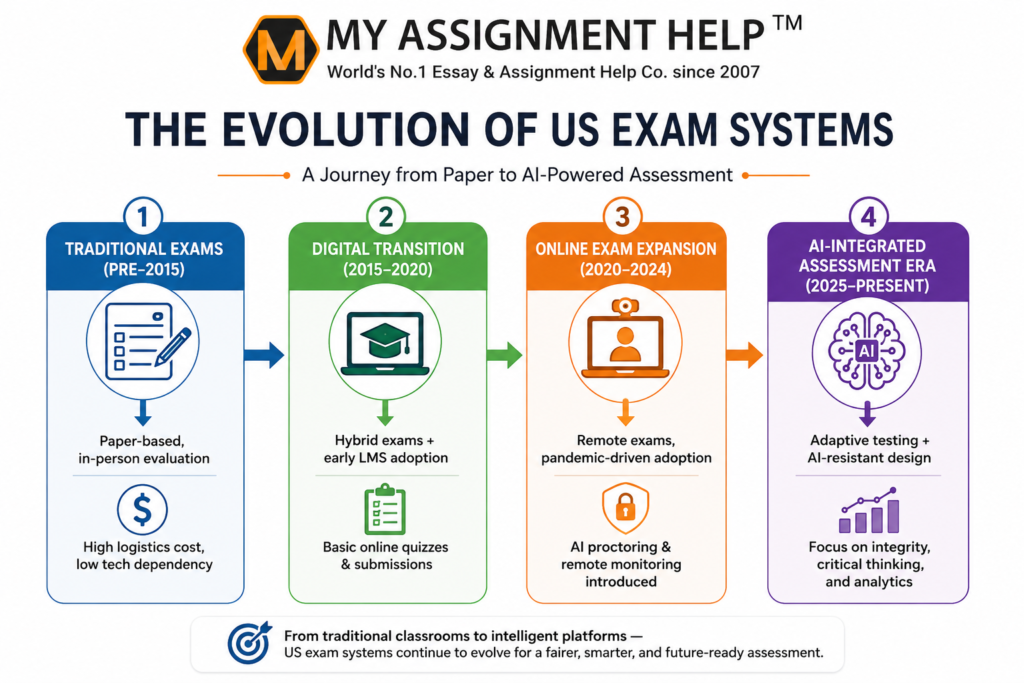
Experts predict that the future of online exams will focus on three major areas:
Instead of fighting AI, universities will design exams that integrate AI responsibly.
More emphasis will be placed on:
Final exams may gradually be replaced by:
This marks a shift from “exam-based success” to “competency-based education.”
See also: Understanding Reputation Systems
As online exams become more complex, students increasingly seek structured academic assistance to manage workload, deadlines, and exam pressure.
Platforms like MyAssignmentHelp provide academic support services, including structured learning guidance and exam preparation assistance through myassignmenthelp and affordable academic resources often described as cheap assignment help for students managing heavy academic loads.
Such services are becoming part of the broader academic ecosystem, especially in high-pressure US university environments.
Not completely, but they are rapidly becoming the dominant mode of assessment in many universities, especially in hybrid learning systems.
AI can assist students in generating answers, which creates challenges for academic integrity and forces universities to redesign assessments.
They are not necessarily harder, but they require stronger time management, technical readiness, and adaptability.
They are using AI proctoring, randomized questions, and critical-thinking-based assessments instead of memory-based questions.
Yes. Online and hybrid exam models are expected to expand further due to flexibility and cost advantages.
Mark William is a Senior Content Strategist at MyAssignmentHelp, specializing in higher education trends, academic writing, and EdTech transformation in US and global universities. With over 8 years of experience in educational content development, he focuses on producing research-backed, SEO-optimized academic insights aligned with EEAT standards. His work regularly explores the intersection of AI, digital learning, and student performance optimization in modern higher education systems.